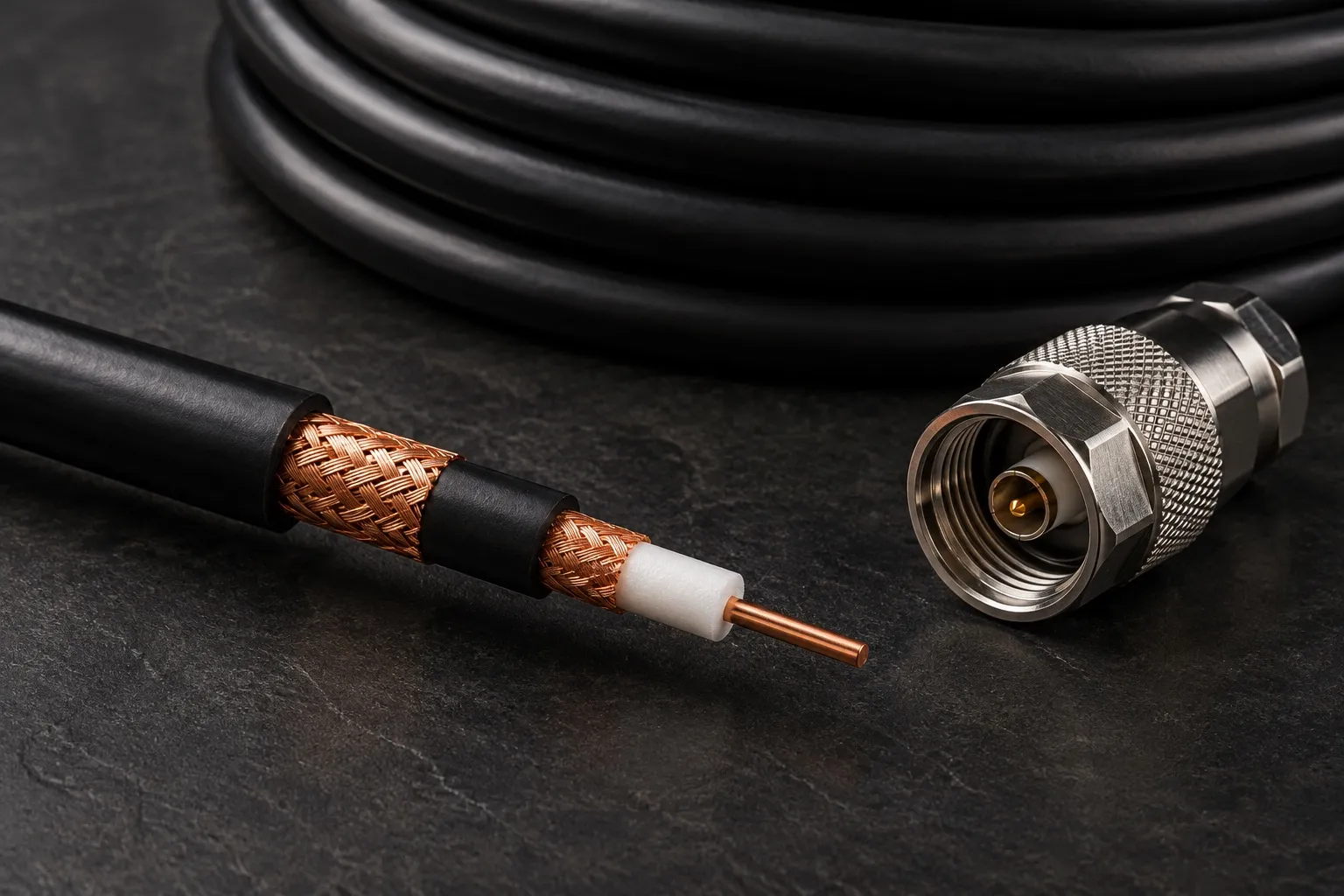
Cable guide
RG58 vs RG8X vs 400-Series: Choosing 50 Ω Coaxial Cable
Thicker coax loses less signal but is harder to route. Choosing a 50 Ω cable comes down to three things: the frequency, the length of the run and the room you have. This guide compares the five cables we supply.
Updated 12 November 2026
The five cables at a glance
| Cable | Outer diameter | Jacket | Best for |
|---|---|---|---|
| RG174 | 2.8 mm | PVC | Short pigtails and GPS antenna leads where space is tight |
| RG316 | 2.5 mm | FEP, −55 °C to +200 °C | Jumpers inside equipment and hot locations |
| RG58 | 5.0 mm | PVC | Patch leads and short runs, up to about 15 m |
| RG8X | 6.1 mm | PVC | Feed lines up to about 30 m on HF, CB and VHF |
| 400-series | 10.3 mm | PE, outdoor rated | Long runs, UHF and above, outdoor feed lines |
All five are 50 Ω. Diameters are typical for each cable type; the datasheet for your order comes with the quote.
See the RF coaxial cable rangeApproximate loss per 100 m
Loss grows with frequency and with length. For a 50 m run, halve the figures; for a 30 m run, take about 30% of them.
| Cable | 150 MHz | 450 MHz | 900 MHz |
|---|---|---|---|
| RG174 | 35 dB | 60 dB | 90 dB |
| RG316 | 29 dB | 52 dB | 75 dB |
| RG58 | 20 dB | 35 dB | 53 dB |
| RG8X | 15 dB | 28 dB | 42 dB |
| 400-series | 5 dB | 9 dB | 13 dB |
Converted and rounded from typical published figures for each cable type. Loss varies between makers and constructions, so use these figures to compare cables, not to sign off a link budget.
What the numbers mean in practice
Every 3 dB of loss halves the power. On a 30 m run at 450 MHz, RG58 loses about 10 dB, so only about a tenth of the transmitter power reaches the antenna. 400-series loses under 3 dB on the same run, so more than half arrives.
Receivers suffer in the same way: loss in the feed line adds directly to the noise figure of the system, so the weakest signals are the first to go.
How to choose
- Note the highest frequency the cable will carry and the length of the run.
- Work out the loss of each candidate from the table and keep the ones within your budget. Many installers aim for 3 dB or less on a transmit feed line.
- Of those, take the thinnest cable that suits the route, the bend radius and the connectors.
- Check the jacket: PE for long outdoor runs in the sun, FEP where it is hot, PVC indoors.
Rules of thumb
- Under about 10 m and below 500 MHz: RG58 is usually enough.
- Up to about 30 m on HF, CB and VHF: RG8X.
- UHF, 800/900 MHz and long outdoor runs: 400-series.
- Inside equipment or near heat: RG316.
- Short GPS leads where every millimetre counts: RG174.
50 Ω and 75 Ω are not interchangeable
RG6 and RG59 are 75 Ω cables for TV, satellite and CCTV. Radio, antenna and test equipment uses 50 Ω. Mixing the two causes a mismatch and reflected power, so match the cable to the impedance of the equipment.
Ordering
Tell us the cable type, the total length or reel lengths you need, the quantity and the destination port.
Ask for a quoteFAQ
Is RG8X better than RG58?
For loss, yes: at the same frequency and length, RG8X loses about 20–25% fewer decibels than RG58. It is thicker and stiffer, though, so RG58 is still the better fit for short patch leads.
What is 400-series coax?
A family of 50 Ω low-loss cables about 10.3 mm (0.405 in) thick, with a foil-and-braid shield and an outdoor PE jacket. It loses about a quarter of what RG58 loses at the same frequency and length. Several makers sell it under their own brand names.
Are RG58 and RG59 the same?
No. RG58 is a 50 Ω cable for radio and test equipment. RG59 is a 75 Ω cable for video and CCTV. They look alike but are not interchangeable.
Send us your cable list
Types, sizes, quantities and destination port. We reply within 24 hours on working days.